
Contact Lens Fitting

Author: Doç. Dr. Elif Ceren Yeşilkaya, Ophthalmologist, Cornea and Refractive Surgery
Published: · Last updated:
Soft, toric, multifocal, rigid gas permeable and scleral lenses, lens options for keratoconus, lens hygiene and the warning signs of infection.
Quick Answer
Contact lens fitting is the process of choosing and trialling a lens that suits the shape of your eye and your prescription, then learning to insert, remove and care for it. Lenses can correct short-sightedness, long-sightedness, astigmatism and presbyopia, and are also used in keratoconus.
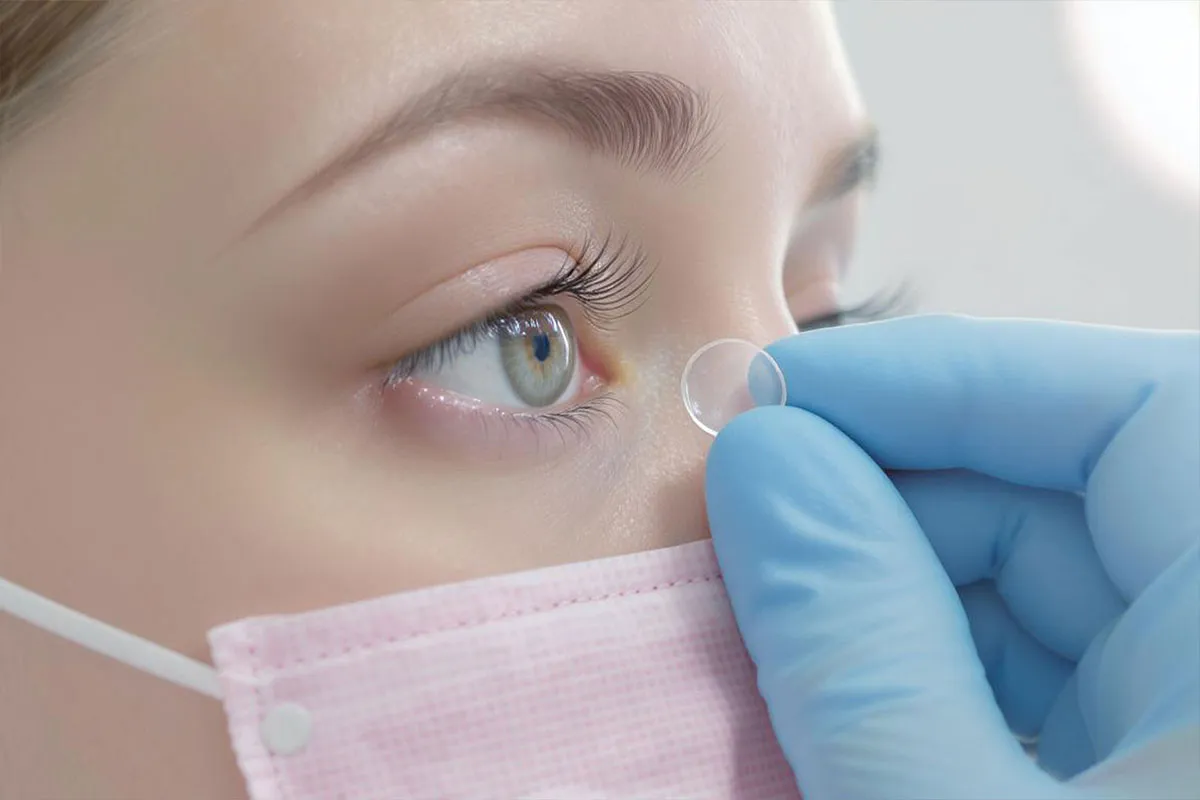
A contact lens is a thin corrective lens that sits on the surface of the cornea. Because it is in direct contact with the eye, it counts as a medical device and is chosen through an eye examination. Lenses can correct short-sightedness (myopia), long-sightedness (hyperopia), astigmatism and the age-related difficulty with near vision called presbyopia. People who prefer not to wear glasses, who play sport, or who find that strong glasses make things look smaller or distorted at the edges often choose lenses. In conditions where the corneal surface becomes irregular, such as keratoconus, specialist lenses often give clearer vision than glasses.
If there is an infection, severe dryness or allergic inflammation on the eye’s surface, lens wear is restricted or postponed until the problem has been treated. For people who cannot follow lens care routines or attend regular check-ups, glasses are the safer choice.
What is measured at a contact lens fitting?
Contact lens fitting starts with a full eye examination:
- Your glasses prescription is checked again and converted into a lens power.
- The curvature of the cornea is mapped with keratometry or corneal topography. The curve of the back of the lens is chosen to match it.
- The amount and quality of your tears are assessed. Dry eye is a common reason people cannot wear lenses comfortably all day.
- The inner eyelids, the cornea and the conjunctiva (the thin membrane over the white of the eye) are examined with a slit lamp, a microscope with a bright light.
A trial lens is then put in. A soft lens is left to settle for a few minutes before the doctor checks how well it centres and how much it moves when you blink. For rigid lenses, an orange dye called fluorescein is put into the eye, and the pattern of tears under the lens shows how it sits on the cornea. Assoc. Prof. Dr. Elif Ceren Yeşilkaya recommends a lens type based on these measurements and on how and where you plan to wear your lenses. If the lens fits well, you are shown how to insert, remove and clean it, and a first follow-up date is set.
Which lens suits which eye?
Soft lenses
Soft lenses are made of a flexible, water-containing material and are the most widely used type. Most people get used to them quickly. Depending on how often they are replaced, there are daily, weekly, monthly and three-monthly options. Daily disposables need no case or solution, and because you put in a fresh pair each morning they have a hygiene advantage. Monthly and three-monthly lenses are cleaned every evening and stored in solution.
Toric lenses
Toric lenses are soft lenses designed to correct astigmatism. In astigmatism the cornea is not curved equally in every direction, so the lens has to stay at a particular angle on the eye. A difference in thickness across part of the lens holds it in that position. When a toric lens rotates, vision blurs and clears through the day, which is why rotation is checked during the trial.
Multifocal lenses
Difficulty with near vision usually starts in the forties. Multifocal lenses carry rings of different power for distance and near on the same lens, and the brain picks the image that matches what you are looking at. How long adapting takes varies from person to person, and some people notice reduced contrast in dim light. Monovision, where one eye is corrected for distance and the other for near, is an alternative.
Rigid gas permeable (RGP) lenses
RGP lenses are made from a firm, oxygen-permeable material and are smaller than soft lenses. Because the lens keeps its shape, the layer of tears trapped between the lens and the cornea fills in surface irregularities. This is why vision with RGP lenses is often sharper than with soft lenses in high astigmatism and keratoconus. You will feel the lens in your eye at first, and adapting takes longer than with soft lenses.
Scleral and hybrid lenses
Scleral lenses are large-diameter rigid lenses. They vault over the cornea without touching it and rest on the white of the eye (the sclera). Before insertion the lens is filled with preservative-free saline, so the cornea stays covered by a layer of fluid all day. They are used in advanced keratoconus, after corneal transplants and in severe dry eye. Hybrid lenses have a rigid centre and a soft outer skirt, aiming to combine the sharp vision of a rigid lens with the comfort of a soft one.
Coloured lenses
Coloured lenses change the colour of the eye and come with or without a prescription. Even without a prescription, they need to be measured and fitted like any other lens.
Which contact lenses are used for keratoconus?
In keratoconus the cornea thins, bulges forward into a cone and develops an irregular surface. Glasses cannot compensate for this irregularity, so as the condition progresses it becomes harder to see clearly with them. In the early stages glasses or toric soft lenses may be enough. As the cornea steepens, RGP lenses are used. In more advanced cases, or when a rigid lens will not stay stable on the eye, hybrid or scleral lenses are tried. Rigid lenses designed for keratoconus have a back surface with a special curve that follows the shape of the cone.
Lenses correct vision but do not stop the cornea from steepening. Lens wearers with keratoconus have topography measurements repeated at regular intervals, and if the condition is progressing, corneal cross-linking is planned to halt it. The fit of rigid and scleral lenses is checked several times while you get used to them.
Daily rules for lens hygiene
- Wash your hands with soap and dry them on a lint-free towel before inserting or removing lenses.
- Never wet your lenses or case with tap water, bottled water or saliva. Keep water out of your eyes in the shower, the pool and the sea while wearing lenses.
- After removing a lens, rub and rinse it in your palm with solution, and put fresh solution in the case. Never top up old solution.
- Stick to the replacement schedule. A monthly lens is thrown away one month after the pack is opened, however many days it has been worn.
- Do not sleep in lenses that are not approved for overnight wear.
- Put your lenses in before applying make-up, and take them out before removing it.
- If you use a hydrogen peroxide care system, do not put the lenses in until the neutralisation time has finished.
Which symptoms mean you should remove your lenses and seek help?
The most serious risk for lens wearers is a corneal infection (microbial keratitis). If treatment is delayed, it can leave a permanent scar and loss of vision. If you notice any of the following, take the lens out, do not put it back in, and have your eye examined the same day:
- Increasing pain or stinging in the eye
- Redness
- Being unable to tolerate light
- Watering or a sticky discharge
- Blurred vision or a white spot on the cornea
Bring the lens and its case with you, as samples can be taken from them for culture if needed. Do not start treating yourself with leftover drops at home, particularly steroid drops.
Stopping lens wear before a laser eye assessment
Contact lenses temporarily change the shape of the cornea. Once you stop wearing them, the cornea gradually returns to its natural shape. The corneal topography and corneal thickness measurements taken at a laser or ICL assessment are the data the treatment plan rests on, and measurements taken before the cornea has settled can give inaccurate results.
How long you need to leave your lenses out depends on the lens type, so ask when you book your appointment. Wear your glasses during this time. If the measurements are unstable, they are repeated at a later visit.
Contact lens examinations and trials take place at the eye clinic of Medicana Zincirlikuyu (Şişli, Istanbul). If you already wear lenses, bring your current glasses and your lens box; the power, curve and diameter printed on the box are compared with the new measurements.
{ AI · preliminary guidance }
onlineLet's talk about your eye health
AI responses do not replace a medical diagnosis.
Frequently Asked Questions
-
Is my contact lens prescription the same as my glasses prescription?
Not always. A spectacle lens sits about 12 mm in front of the eye, while a contact lens rests directly on the cornea. Above roughly 4 dioptres this difference in distance changes the power needed. The curve and diameter of the lens are also chosen for your eye, which is why a separate contact lens examination and trial are done.
-
Can I sleep in my contact lenses?
Sleeping in lenses markedly increases the risk of corneal infection. Only lenses approved for overnight wear can be left in, on your doctor's advice and for the agreed period. Do not nap in daily-wear lenses, even briefly.
-
Can I swim in contact lenses?
Contact with tap, pool or sea water can lead to corneal infections such as Acanthamoeba keratitis, which are difficult to treat. Not wearing lenses for swimming is the safest choice. If you must, wear tight-fitting swimming goggles and throw away daily lenses once you are out of the water.
-
Are coloured contact lenses harmful?
Coloured lenses without a prescription are still medical devices. A lens that does not fit can scratch the cornea or cause infection. They should be chosen after measurements at an eye examination, not bought online or from cosmetic shops without a fitting, and never shared.
-
Do I need to stop wearing lenses before a laser eye assessment?
Yes. Lenses temporarily change the shape of the cornea, so they are left out for a while before the measurements. How long depends on your lens type. Ask when you book the assessment and you will be told the period that applies to you.
-
Do lenses stop keratoconus from getting worse?
No. Lenses smooth out the irregular corneal surface optically and sharpen vision, but they have no effect on the thinning and steepening of the cornea. Lens wearers with keratoconus therefore have topography repeated regularly, and if the condition is progressing, treatment such as corneal cross-linking is planned.
-
Can I wear contact lenses if I have dry eyes?
With mild dryness, lens materials that hold moisture better, daily disposable lenses and lens-compatible drops can make wear easier. If dry eye is significant, it is treated first. In some patients with severe dry eye, scleral lenses can be an option because they keep the cornea covered with fluid.
-
How often should I replace my lens case?
Rinse the case with lens solution after each use, leave it to air-dry upside down, and replace it at least every three months. Empty the case completely each time and fill it with fresh solution rather than topping up the old.
- Published
- Last updated
Appointment
Would you like more information?
A short form about Contact Lens Fitting. We reply during working hours.
Treatments often evaluated together
-
Keratoconus Treatment
Keratoconus usually starts in the teenage years. Topography follow-up, corneal cross-linking (CXL), rigid and scleral lenses, rings and transplant.
-
Laser Eye Surgery (PRK, LASIK, SMILE)
How PRK, No-Touch, LASIK and SMILE Pro differ, which corneal measurements decide whether you are a candidate, and how to look after your eyes afterwards.
-
Dry Eye Treatment
Causes of dry eye, the tear tests done at examination, choosing artificial tears, lid hygiene, punctal plugs and dry eye checks before laser surgery.
The first step is an examination.
Your details reach Dr. Yeşilkaya's team, and we will get back to you during working hours.
+90 537 858 78 07